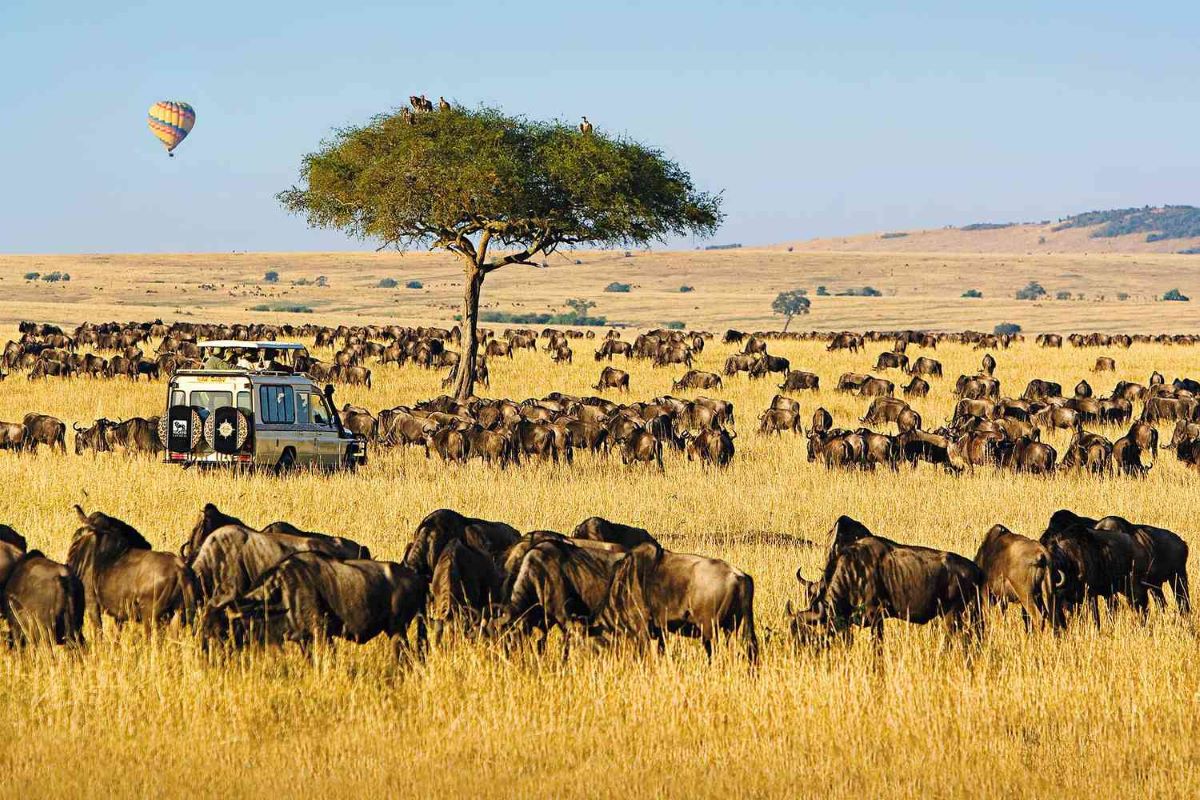
Maasai Mara National Reserve is one of Africa’s most celebrated wildlife destinations and the jewel of Kenya’s safari country. Located in southwestern Kenya, the reserve is renowned for its sweeping grasslands, abundant wildlife, exceptional predator sightings and the spectacular Great Wildebeest Migration.
The Mara is more than a place to see animals. It is a vast living ecosystem where lions patrol the plains, cheetahs hunt across open grasslands, elephants move through the savannah, giraffes browse among acacia trees and enormous herds of wildebeest and zebras move across the landscape in search of fresh grazing.
The reserve forms part of the larger Mara-Serengeti ecosystem, which extends southwards into Tanzania’s Serengeti National Park. This connected ecosystem allows wildlife to move across a much larger landscape following seasonal patterns of rainfall, water and food.
For travellers seeking an authentic African safari, few destinations provide the concentration and variety of wildlife found in the Maasai Mara.
Where Is Maasai Mara National Reserve?
Maasai Mara National Reserve is located in Narok County in southwestern Kenya, close to the Tanzania border.
The reserve forms part of the greater Mara ecosystem, which includes community conservancies and other wildlife areas surrounding the main reserve.
Its location makes it one of the most important wildlife areas in Kenya and an essential destination on many Kenya safari itineraries.
The Mara landscape is characterized by expansive open grasslands, rolling hills, riverine forests, seasonal streams and acacia woodland.
What Is Maasai Mara Famous For?
Maasai Mara is famous for several remarkable features.
1. The Big Five
The reserve is one of Kenya’s best destinations for seeing the Big Five:
- Lion
- Leopard
- Elephant
- African buffalo
- Rhinoceros
Wildlife sightings are never guaranteed because animals are free to roam, but the Mara’s rich ecosystem provides excellent opportunities to encounter these iconic species.
2. The Great Wildebeest Migration
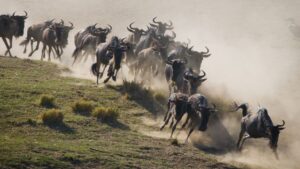
The Great Wildebeest Migration is perhaps the Mara’s most famous natural spectacle.
Every year, enormous numbers of wildebeest, accompanied by zebras and other herbivores, move through the greater Mara-Serengeti ecosystem.
When the herds reach the Mara River, dramatic river crossings can occur. These crossings are unpredictable and depend on animal movements and environmental conditions.
3. Exceptional Big Cat Viewing
The Mara is particularly famous for its large population of predators.
Lions can often be found resting beneath trees or patrolling the plains. Cheetahs use the open grasslands to hunt, while elusive leopards may be encountered around areas of thicker vegetation and riverine forest.
This makes the reserve one of the world’s most exciting destinations for big-cat safaris.
The Landscape of Maasai Mara
One of the greatest attractions of the Maasai Mara is its landscape.
The reserve is dominated by open rolling grasslands, creating long sightlines that make wildlife easier to spot. Scattered acacia trees, rocky outcrops and seasonal watercourses add variety to the scenery.
During the dry season, the grasslands can turn golden, producing the classic African safari landscape.
After rainfall, the plains can become green and vibrant, with fresh vegetation attracting large numbers of herbivores.
The changing appearance of the Mara throughout the year is one reason repeat visitors can experience the reserve differently on every visit.
The Mara River
The Mara River is one of the most important features of the greater Mara ecosystem.
It provides a vital source of water for wildlife and supports a rich riverine environment.
The river is particularly famous because it forms part of the route taken by migrating wildebeest and zebras.
During the migration season, the river crossings can become dramatic wildlife events as thousands of animals gather along the banks before attempting to cross.
However, river crossings should never be treated as a scheduled attraction. Wildlife movements are natural and unpredictable, and there is no guarantee that a crossing will occur during a particular visit.
Wildlife in Maasai Mara National Reserve
The abundance and variety of wildlife are what make the Maasai Mara so special.
Lions
The Mara is one of Kenya’s premier destinations for lion viewing.
Lion prides can often be found resting in the shade during the heat of the day and becoming more active during the cooler morning and evening hours.
Watching a pride interact, hunt or care for young cubs can be one of the most memorable experiences of a Maasai Mara safari.
Leopards
Leopards are more elusive than lions and require patience and an experienced guide to locate.
They often use trees and areas of dense vegetation for resting and may be active during the early morning, late afternoon and evening.
Cheetahs
The open grasslands of the Mara provide excellent habitat for cheetahs.
Their incredible speed makes a cheetah encounter particularly exciting, especially when one is preparing to hunt.
Elephants
Elephants are an important part of the Mara ecosystem.
They can be seen moving across the plains, feeding on vegetation or gathering near water.
Buffaloes
Large buffalo herds can be encountered throughout the reserve. Their size and strength make them one of the most impressive herbivores to see on a game drive.
Rhinoceros
Black rhinoceros are present in the greater Mara ecosystem but are considerably more difficult to find than many other large mammals. Seeing one is therefore a special safari experience.
Giraffes
Giraffes add an unmistakable African character to the Mara landscape. They can often be seen browsing on trees or moving elegantly across the plains.
Zebras and Wildebeest
Zebras and wildebeest are among the most visible herbivores in the reserve and become particularly important during the annual migration.
Other wildlife includes:
- Hippos
- Hyenas
- Topi
- Elands
- Thomson’s gazelles
- Grant’s gazelles
- Impalas
- Warthogs
- Jackals
- Baboons
- Ostriches
The Great Wildebeest Migration in Maasai Mara
The Great Wildebeest Migration is one of the world’s most extraordinary wildlife events.
Millions of wildebeest, together with large numbers of zebras and gazelles, move through the Mara-Serengeti ecosystem in response to seasonal rainfall and the availability of fresh grazing.
When the herds enter the Maasai Mara, predators such as lions, cheetahs, leopards and hyenas take advantage of the abundance of prey.
The Mara River crossings are among the most dramatic moments associated with the migration. Thousands of wildebeest may gather along the riverbanks, sometimes waiting for hours or even days before crossing.
The important thing to remember is that nature does not follow a calendar. The exact timing, location and number of crossings vary from year to year.
Predators of the Maasai Mara
One of the things that separates the Maasai Mara from many safari destinations is the extraordinary relationship between predators and prey.
The abundance of herbivores supports a thriving predator population.
Lions
Lions are among the Mara’s most iconic predators and can often be observed in prides.
Cheetahs
Cheetahs rely on their incredible acceleration to chase smaller antelope across open ground.
Leopards
Leopards are masters of stealth and are often more difficult to locate than lions and cheetahs.
Hyenas
Spotted hyenas are highly intelligent and social predators. They are important members of the Mara ecosystem and can often be heard calling across the plains.
African Wild Dogs
African wild dogs are much rarer sightings in the Maasai Mara than lions, cheetahs and hyenas. Their presence in the wider region makes an encounter particularly exciting.
Birdlife in Maasai Mara
The Mara is not only a destination for large mammals.
Its varied habitats support a wide range of bird species, making it an excellent destination for birdwatchers.
Depending on the season and location, visitors may encounter:
- Ostriches
- Secretary birds
- Vultures
- Eagles
- Kori bustards
- Lilac-breasted rollers
- Storks
- Egrets
- Herons
- Hornbills
The open plains provide excellent opportunities for spotting large birds of prey and ground-dwelling species.
The Maasai Mara Ecosystem
It is important to understand that Maasai Mara National Reserve is only part of the greater Mara ecosystem.
Wildlife does not recognize human boundaries.
Animals move between the reserve, surrounding community lands and conservancies in search of food, water and suitable habitat.
The surrounding conservancies therefore play an important role in maintaining wildlife corridors and protecting habitat.
This relationship between wildlife conservation, tourism and local communities is fundamental to the long-term future of the Mara.
Maasai Mara Conservancies
Around the main reserve are several community conservancies that provide additional wildlife habitat and support local communities.
Conservancy experiences can offer a more private and intimate safari environment, depending on where you stay.
Some conservancies allow activities that may be restricted within the national reserve, such as certain walking safaris and night game drives, subject to local rules.
This means travellers can combine a visit to Maasai Mara National Reserve with a conservancy experience for a broader understanding of the Mara ecosystem.
Best Time to Visit Maasai Mara National Reserve
The Maasai Mara can be visited throughout the year.
However, different seasons offer different experiences.
July to October
These months are widely associated with the Great Wildebeest Migration and are popular with travellers hoping to witness large herds in the Mara.
Wildlife viewing is also generally excellent because of relatively dry conditions.
However, the exact timing of the migration varies every year.
November to December
The short rains can bring fresh green vegetation to the plains.
The landscape becomes beautiful and wildlife remains abundant.
January to February
These months can provide excellent general wildlife viewing, with relatively dry conditions and good opportunities to see predators and herbivores.
March to May
The long-rain period can transform the Mara into a lush green landscape.
There can be fewer visitors, although wet weather can affect some roads and driving conditions.
There is no single perfect time to visit the Maasai Mara. The best period depends on whether your priority is migration, general wildlife viewing, photography, birdwatching or avoiding peak-season crowds.
What Makes Maasai Mara Different From Other Kenya Parks?
Every Kenyan national park has its own character.
The Mara stands out because of its exceptional combination of predators, herbivores, open grasslands and seasonal wildlife movements.
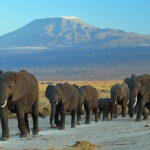
Compared with Amboseli, which is particularly famous for elephants and Mount Kilimanjaro scenery, the Maasai Mara is especially renowned for big cats, expansive savannah and the Great Migration.
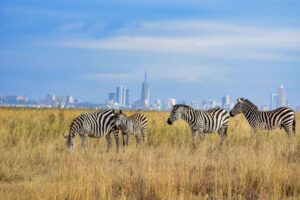
Compared with Lake Nakuru, which is known for its lake environment, rhinos and birdlife, the Mara offers a much larger open-grassland ecosystem.
This makes the Maasai Mara an essential part of a classic Kenya safari.
Why Visit Maasai Mara National Reserve?
1. Exceptional wildlife
The Mara supports an extraordinary variety of mammals and birds.
2. Big Five opportunities
Lions, elephants, buffaloes, leopards and rhinoceros can all be found in the Mara ecosystem.
3. World-famous predators
The reserve is particularly rewarding for travellers interested in lions, cheetahs and leopards.
4. Great Wildebeest Migration
The annual movement of wildebeest and zebras makes the Mara one of the world’s most famous wildlife destinations.
5. Beautiful landscapes
The endless grasslands create the classic African safari scenery.
6. Photography
The combination of wildlife, open plains, dramatic skies and golden light makes the Mara a dream destination for photographers.
7. Maasai culture
The surrounding communities provide opportunities to learn about Maasai traditions and the relationship between people and wildlife.
How to Get to Maasai Mara National Reserve
Maasai Mara National Reserve can be reached by road or air, making it accessible from Nairobi and other major safari destinations in Kenya.
By Road from Nairobi
The most popular way to travel to Maasai Mara is by road from Nairobi. The journey generally takes around 5–6 hours, depending on the route, traffic, road conditions and the entrance gate being used.
A road safari offers the advantage of seeing more of the Kenyan countryside along the way. Many travellers combine Maasai Mara with destinations such as Lake Nakuru, Lake Naivasha or Amboseli to create a longer Kenya safari.
For a comfortable safari, a 4×4 Land Cruiser is recommended, particularly during rainy periods when some roads around the Mara can become challenging.
The main gates and access points include Sekenani, Talek, Oloolaimutia, Oloololo and Musiara, with the appropriate gate depending on your accommodation and which part of the Mara ecosystem you are visiting.
By Air
Flying is the fastest way to reach Maasai Mara.
Scheduled and chartered flights operate from Nairobi’s Wilson Airport to several airstrips serving different parts of the Mara ecosystem. Flight time is generally around 45 minutes to 1 hour, depending on the destination and stops.
Flying is particularly convenient for travellers staying at luxury camps, visitors with limited time, or those combining Maasai Mara with other destinations such as the Kenyan coast or Amboseli.
Things to Do in Maasai Mara
The primary experience in the reserve is wildlife viewing by safari vehicle, but the wider Mara ecosystem offers additional experiences.
Popular activities include:
- Morning game drives
- Afternoon game drives
- Full-day game drives
- Big Five wildlife viewing
- Predator tracking
- Birdwatching
- Photography
- Great Migration viewing
- Maasai cultural experiences
- Hot-air balloon safaris
- Walking safaris in permitted conservancy areas
Activities vary depending on whether you are staying inside the reserve or in a surrounding conservancy.
Maasai Mara Balloon Safari
A hot-air balloon safari over the Maasai Mara is one of the most spectacular ways to experience the reserve.
The experience usually begins before sunrise. Guests are transferred to the launch site and watch the balloon being prepared before rising above the Mara as the sun begins to appear over the horizon.
From the air, the enormous scale of the Mara becomes clear. You can look down over the golden grasslands, winding rivers, woodland and wildlife moving across the plains.
Depending on the location and conditions, you may see wildebeest, zebras, elephants, giraffes, buffaloes and other wildlife from above.
After the flight, guests are typically treated to a bush breakfast before returning to their camp or lodge.
How Much Does a Maasai Mara Balloon Safari Cost?
Balloon safari prices vary by operator, season and package. As a premium experience, it is normally charged separately from the standard safari package and park fees.
A balloon safari is particularly popular with honeymooners, couples, photographers and travellers celebrating special occasions.
Accommodation Around Maasai Mara
Travellers can choose from a wide range of accommodation, including budget camps, mid-range safari camps, luxury lodges and premium tented camps.
Accommodation options are found both inside and around the reserve, as well as in private and community conservancies.
When choosing where to stay, consider:
- Distance to the reserve gates
- Location within the Mara ecosystem
- Wildlife viewing opportunities
- Type of safari vehicle
- Meal plan
- Level of luxury
- Family suitability
- Private conservancy access
Staying close to the reserve can maximize game-drive time, while a conservancy stay can provide a more exclusive safari experience.
Maasai Mara National Reserve Park Fees
Maasai Mara National Reserve is managed by the Narok County Government, rather than Kenya Wildlife Service. Park entry fees are therefore set through the Narok County tourism and finance framework.
2026 Maasai Mara Entry Fees
For 2026, the published rates for non-resident visitors are:
| Visitor | January–June 2026 | July–December 2026 |
|---|---|---|
| Non-resident adult | USD 100 | USD 200 |
| Child 9–17 years | USD 50 | USD 50 |
| Child 8 years and below | Free | Free |
Kenyan citizens and East African residents pay different rates in Kenya shillings, depending on their visitor category.
Important: 12-Hour Ticket
Maasai Mara introduced a 12-hour ticket validity period, generally covering 6:00 AM to 6:00 PM. This means travellers should plan their game drives and accommodation carefully because an afternoon entry followed by a full game-drive day can result in two days of entry fees.
Park fees can change, so travellers should confirm the current rates when booking their safari.
How Many Days Do You Need in Maasai Mara?
A 3-day Maasai Mara safari is a popular choice for travellers visiting Kenya for a short wildlife holiday.
However, 4 to 5 days can provide a more relaxed experience, particularly for travellers who want to explore different parts of the ecosystem or combine the reserve with a private conservancy.
If you are visiting during the migration season, additional nights can be worthwhile because wildlife movements and river crossings are unpredictable.
Responsible Tourism in the Maasai Mara
The future of the Mara depends on responsible tourism.
Visitors should:
- Keep a respectful distance from wildlife.
- Remain inside designated safari vehicles where required.
- Never feed animals.
- Avoid littering.
- Follow the instructions of their driver-guide.
- Avoid overcrowding wildlife sightings.
- Respect local communities and cultural traditions.
- Support responsible accommodation and tourism operators.
A responsible safari helps ensure that the Mara remains a healthy wildlife ecosystem for future generations.
Maasai Mara National Reserve: A True African Wilderness
The Maasai Mara National Reserve is much more than a place to tick the Big Five off a list.
It is a living landscape where wildlife interactions happen every day. A lion pride may spend the morning resting beneath an acacia tree. A cheetah may scan the plains for prey. Elephants may cross a distant ridge while giraffes move through the grasslands.
Then, during the migration season, the landscape can change dramatically as enormous herds of wildebeest and zebras arrive in search of fresh grazing.
This combination of wildlife abundance, dramatic landscapes, predators, seasonal movements and cultural heritage is what makes Maasai Mara one of Africa’s greatest safari destinations.
If Kenya is your gateway to an African safari, the Maasai Mara deserves a place at the heart of your journey.
Frequently Asked Questions About Maasai Mara National Reserve
Is Maasai Mara National Reserve worth visiting?
Yes. Maasai Mara is one of Africa’s premier wildlife destinations and is particularly famous for its abundant wildlife, big cats, Big Five sightings, beautiful savannah landscapes and the Great Wildebeest Migration.
What is Maasai Mara famous for?
The Maasai Mara is famous for the Big Five, large lion populations, cheetahs, leopards, open savannah landscapes and the Great Wildebeest Migration.
Where is Maasai Mara located?
Maasai Mara National Reserve is located in Narok County in southwestern Kenya, near the Tanzania border.
What animals can I see in Maasai Mara?
You can see lions, leopards, cheetahs, elephants, buffaloes, rhinoceros, giraffes, zebras, wildebeest, hippos, hyenas, gazelles and many other animals.
Can I see the Big Five in Maasai Mara?
Yes. The Mara ecosystem supports lion, leopard, elephant, buffalo and rhinoceros, although wildlife sightings are never guaranteed.
When is the Great Migration in Maasai Mara?
The wildebeest migration generally reaches the Maasai Mara around the middle part of the year, often between July and October, but the timing varies annually according to rainfall and grazing conditions.
How many days should I spend in Maasai Mara?
A 3-day safari is a good introduction, while 4–5 days allows more time to explore the reserve and surrounding ecosystem at a relaxed pace.
Can I visit Maasai Mara all year round?
Yes. The reserve is open for wildlife experiences throughout the year, with each season offering different scenery and wildlife opportunities.
Is Maasai Mara good for families?
Yes. The Mara can be an excellent family safari destination. Families should select suitable accommodation and follow all wildlife-safety instructions provided by their safari guide.
Can Maasai Mara be combined with other Kenya destinations?
Yes. Popular combinations include Maasai Mara and Lake Nakuru, Maasai Mara and Lake Naivasha, Maasai Mara and Amboseli, and longer Kenya circuits covering several national parks and reserves.
Plan Your Maasai Mara Safari
Ready to experience the wild heart of Kenya?
Delight Rose Safaris can arrange private and group Maasai Mara safari experiences, including transport, accommodation, game drives and carefully planned itineraries based on your travel dates, budget and preferred safari style.
Experience the magic of the Maasai Mara — where the plains are alive, predators rule the grasslands, and every game drive brings a new African story.
Delight Rose Safaris — Your African Safari Partner.